
Six Feet of Ground
If you visit the National Archives and stand in front of the physical print of this panorama, you can't take it in at once. It's nearly six feet wide. You have to walk the length of it, leaning in to trace the roughly 2,000 yards the British 46th Division were ordered to cover at the Battle of the Somme.
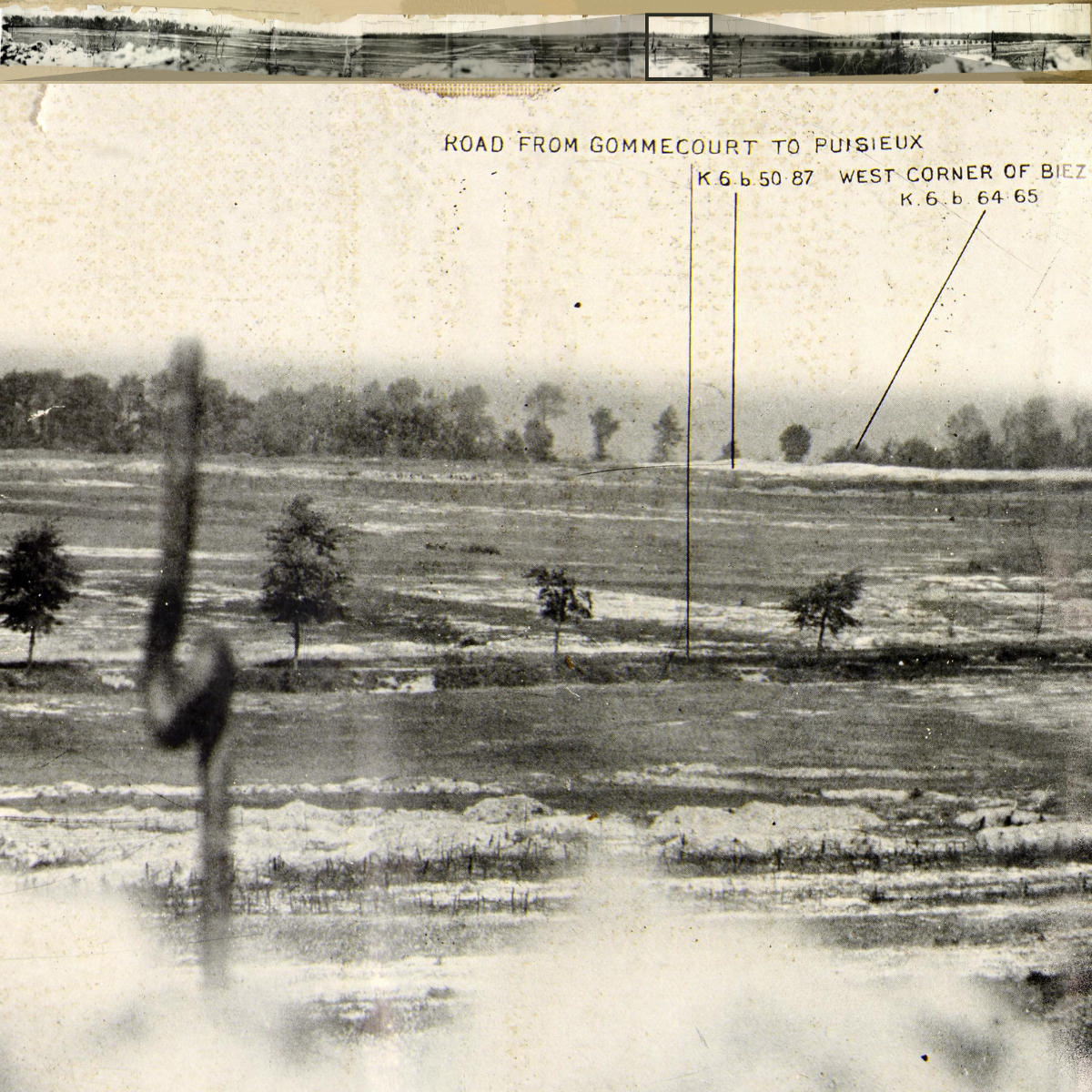
Third Army. “Panorama of Gommecourt.” Monochrome panoramic photo-mechanical print, 20 May 1916. War Office: Directorate of Military Survey and Geographical Section General Staff: Maps and Plans. The National Archives, Kew, UK. WO 316/38.
On 20 May 1916, a Royal Engineer hauled a large-format camera—thirty pounds of wood, brass, and glass—up into the forward trenches. Thirteen glass plates, each one overlapping the last, the lens panning slowly across No Man's Land.
Two hundred and fifty yards away (in view of the lens) the German 2nd Guard Reserve Division held a fortified stretch of the 22-mile Somme front. Their real advantage didn't show at ground level, but it was obvious from above. They called it the Z: a sharp kink in the line that stuck out toward the British and let their machine-guns rake the whole field.
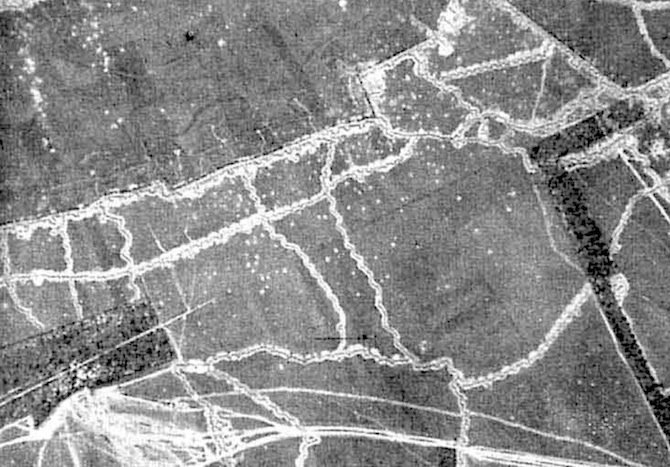
British aerial reconnaissance photograph of German front‑line and support trenches near Gommecourt, spring 1916, showing the maze of defenses before the opening of the Somme offensive.
Along the British side, Kitchener's Army—the Great Improvisation of 1914—had come together in the hundreds of thousands. Clerks, miners, laborers. Men who knew how to keep a ledger or swing a hammer. They loaded munitions. They kept track of their own movements, rations, and ordnance in neat columns. And they waited.
By late June, the Royal Engineer's panorama had been developed and was lying flat on a table. Officers of the 46th Division bent over the horizon line, pencilling arrows and notes into the sky, matching trench numbers to the latest aerial photographs—often only days old.
On 24 June, the British opened what was meant to be a five-day bombardment of the German line; bad weather stretched it to seven. A heavy, stacked thunder from the guns behind, the higher crack of shells on the far slope, cups and lamp-glass rattling as the ground kicked underfoot whenever a one landed close.
By Zero hour on 1 July, the rain had gone but left the air close and muggy. The trenches smelled of damp timber, cordite, wet wool. With the sun climbing out of the north-eastern sky, the light ran straight along the British line and onto the bare chalk ahead, turning the German front into a pale, glaring strip. Officers checked their watches, called out platoons by name, shifted men so each lane was properly filled in the last minutes before the whistles.
Here in a nation's archive, this image preserves the field before 1 July—when the clerks and laborers of the 46th Division, their uniforms unmussed, had yet to step forward toward this view.
By evening, at least one in five would be killed, wounded, or missing.
I found my way to this ground because of one of my wonderful clients. I was building a story for a Royal Engineer named Alexander Christie—following him from enlistment to the Somme and the years after—when another nineteen‑year‑old kept turning up in the files. Somewhere between the panorama, the battalion diaries, and the casualty lists, Henry Alfred Monk became one of the 19,240 men I had to tell Alexander’s family did not come home.
