
Not Just a Logo: The Men Behind Cleveland’s Guardians
For ninety‑one years, the men who carved Cleveland’s most famous statues went unnamed. In the same stretch of time, the bridge they worked on got a commemorative name, and so did the baseball team that plays in its shadow.
That’s one way American monuments work: capital letters for the people on the plaque, lowercase for the people with dust in their lungs.
The Cleveland Guardians rebrand is usually told as a redemption story. The franchise drops a racist name and picks one tied to local architecture—the “Guardians of Traffic” on the Hope Memorial Bridge. It’s easier to clap for that than for yet another corporate‑naming deal, and honestly, fair enough.
But if you actually walk the bridge—if you stand under those pylons instead of just glimpsing them from the ballpark—another story comes into view: private entities cashing in on public symbols, and the people who made those symbols stuck offstage, no credit, no cut.
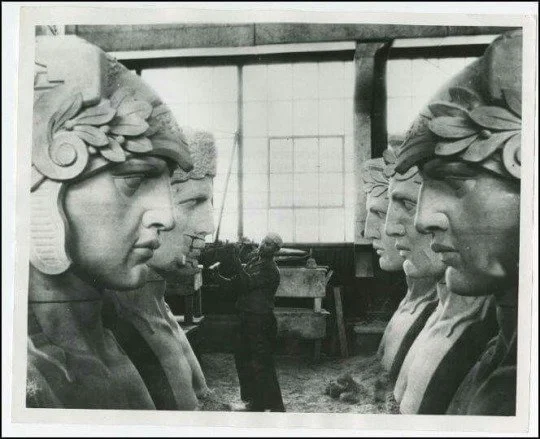
Stonecutter and Guardians at Ohio Cut Stone, ca. 1931. Courtesy of Western Reserve Historical Society.
The statues are gorgeous. Forty‑plus feet of Art Deco sandstone, Hermes in a hard hat, holding everything from a covered wagon to a 1930s truck. Designed at the start of the 1930s and finished in the teeth of the Depression, they’ve watched ore boats and blast furnaces, wartime shifts and river fires, and now SUVs and fans drifting toward the stadium in search of craft beer.
The figures themselves were carved on Random Road in Little Italy. Not by “Cleveland” in the abstract, but by Italian immigrants—scalpellini, stonecutters—from a small town in Italy called Oratino. Recruited into the monument trade through Giuseppe Carabelli’s shop, they spent their careers carving headstones and civic stonework, cutting other people’s names into stone meant to outlast everyone who read it.
On paper, the pattern is familiar. The bridge carries the Hope family name, honoring a local stonemason father and, by reflected light, his famous son Bob. The statues get a collective title—Guardians of Traffic—and eventually a starring role in Major League Baseball branding. The people who turned raw blocks into those figures are “a crew of workmen,” which has about as much personality as “miscellaneous labor.”
Then the team steps in.
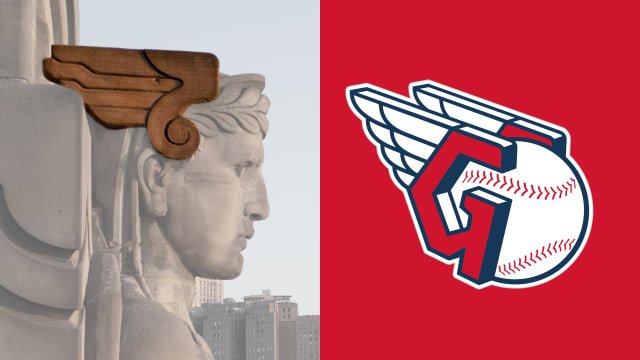
Guardians of Traffic statue and Cleveland Guardians winged‑G logo. From Cleveland Guardians official site.
In 2021, facing pandemic-era sales slumps and mounting pressure to acknowledge the problematic history behind their name, the team announced they were rebranding. The launch video does a slow, reverent pan around those sandstone faces. Press releases explain that the sculptures “have come to symbolize the spirit of Cleveland—resilient, hard‑working and loyal.” The merch drops. The winged G and the wordmark echo the bridge’s geometry. The message is clear: this isn’t just a new logo, it’s a lineage.
From a distance, it reads as homage. Up close, it looks like what it is: the city and a bunch of long‑dead immigrants took on the risk; a franchise takes the vibes.
Nobody in the front office ordered those stones or froze on that scaffold in January wind over the Cuyahoga. Nobody in the design meeting had to rinse rock dust out of their hair for years. But the accumulated meaning of that work—the sense that these figures “stand for” Cleveland—turns out to be excellent raw material when you need to reassure fans and sponsors that you’ve changed everything and nothing at the same time.
This isn’t a scandal. It’s just how the machine runs. Public builds the thing. Workers make the thing. Over time, the thing becomes “iconic.” Sooner or later, somebody with a brand deck notices and says: we should own that.
And then, underneath all of that, a smaller story that almost nobody outside Little Italy saw.
In May 2023, on a side street most fans will never drive down, an Ohio Historical Marker went up at the old Ohio Cut Stone site on Random Road. The plaque does what the press releases and ballpark tours never did: it names the sculptors. It says out loud that the Guardians were carved by Italian immigrant stonecutters from Oratino and lists them—Chiocchio, Cipullo, Fatica, Petti, Tirabasso, and more.
It doesn’t change who owns the trademarks or who gets paid when a kid buys a cap. It will never compete with a Major League media rollout or a 13‑year naming‑rights deal. But it does something archivists and historians recognize immediately: it amends the record. It cracks the façade of inevitability.
It reminds you that symbols don’t just fall from the sky into a merch catalog. Somebody orders the stone. Somebody lifts the block. Somebody stands there, hour after hour, with a chisel and a deadline. Somebody decides whose name gets stamped in metal and whose gets folded into “workmen.”
For the Office of Special Collections, the Hope Memorial Bridge stops being just a pretty backdrop and becomes a file on how public monuments turn into private assets while the people who made them fade into the white space. That little brown marker on Random Road is a note in the margin that basically says: this isn’t just a logo. These are somebody’s fingerprints.
And if that’s true here, on this bridge, it’s true in a lot of other places. Part of the work—for archives, for historians, for anyone who cares who built what we live with—is to go looking for those fingerprints, and, when possible, write those names back in.
For the record—and the archive—here are the names currently known to have worked on the Guardians of Traffic at Ohio Cut Stone on Random Road. This list comes from research by the Western Reserve Historical Society and Little Italy community historians, and appears on or alongside the 2023 “Sculptors of Guardians” marker:
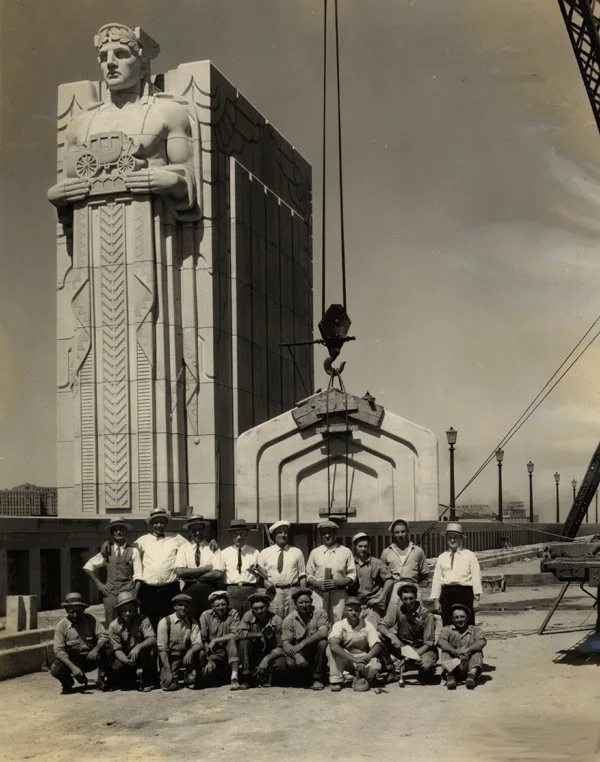
Work crew during installation of a Guardians of Traffic pylon on the Lorain–Carnegie Bridge, 1932. Courtesy of Western Reserve Historical Society.
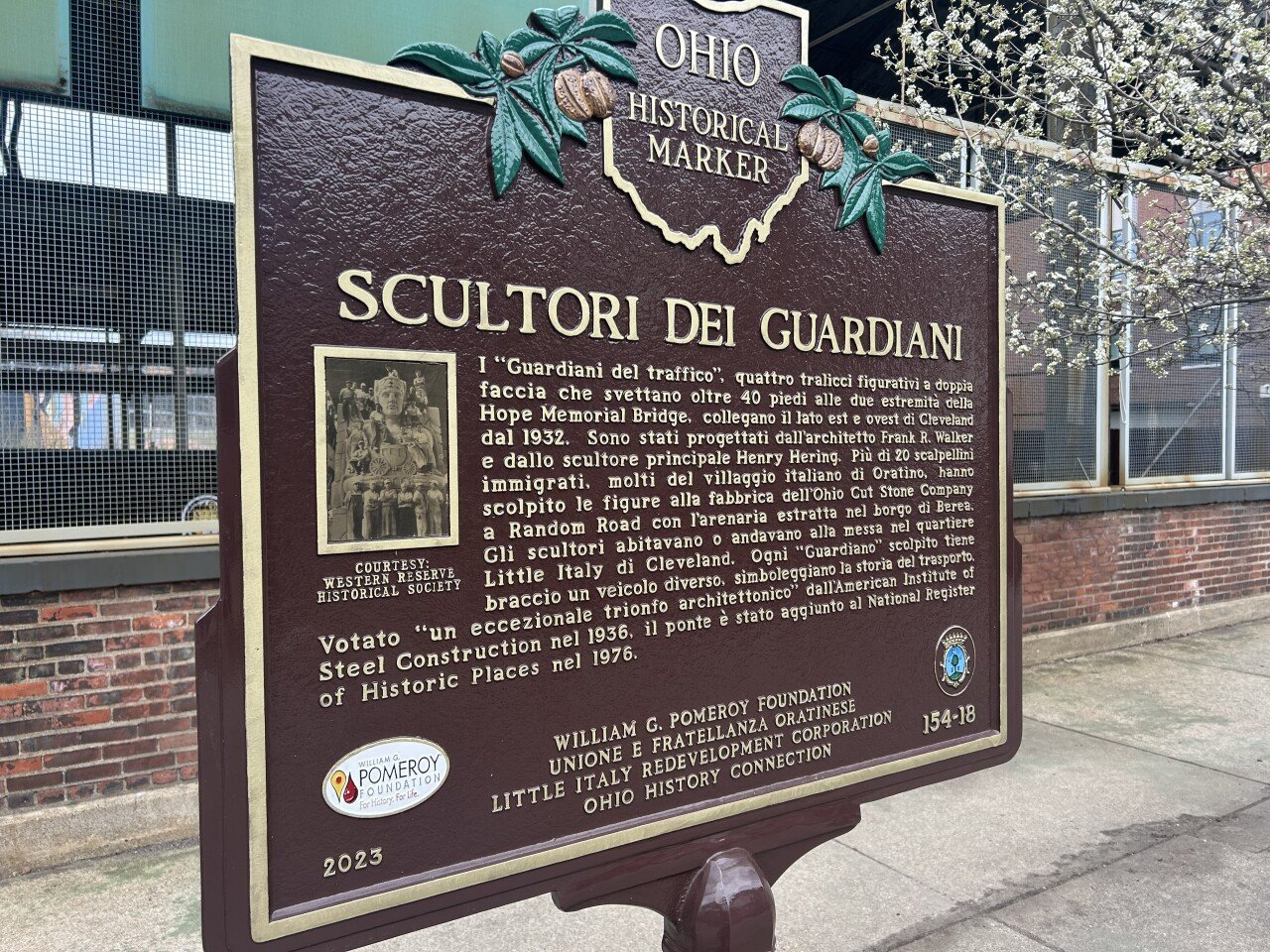
Sculptors of Guardians / Scultori dei Guardiani Ohio Historical Marker, Random Road, Cleveland.
Bill Anslow
Thomas P. Campbell
Antonio Chiocchio (lead)
Carmen Chiocchio
Gennaro Chiocchio
Anthony Cipullo
Frank Cipullo
Louis Cirelli
Anthony Fatica
Celestino Fatica
Fiorangelo Fatica
Gennaro Fatica
Pasquale Fatica
Sam Gentile
William Henry Hope
Charles Iafelice
Frank Leonardi
Domenicantonio Mastrangelo
Jack O’Brien
Cosimo Palante
Celestino Petti
Loreto Petti
Peter Salvatore
Albert Tirabasso
Henry Tirabasso
Andrew Waddell
Charles Waddell
